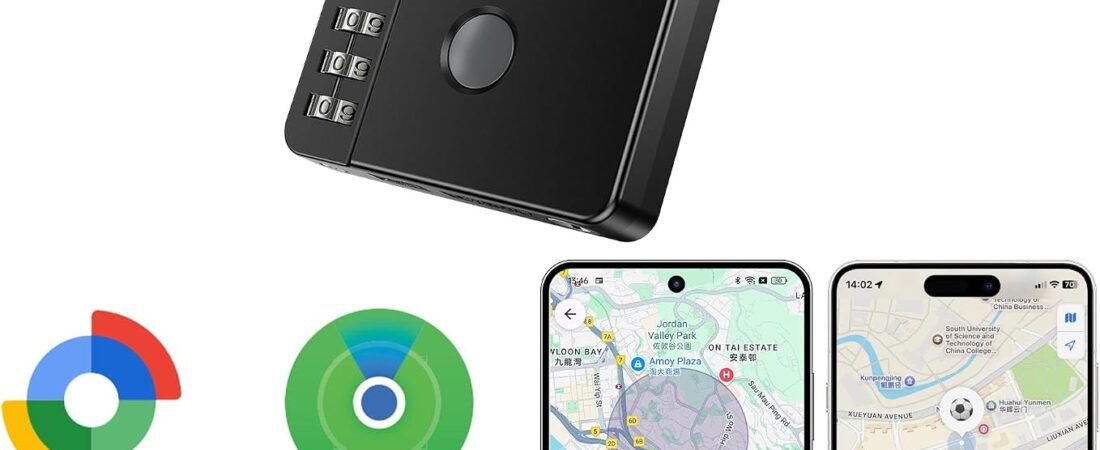
Traveling with checked luggage, backpacks, laptop bags, or other personal belongings often involves two separate concerns: keeping the item physically secured and knowing where it is. Traditional luggage locks can help with the first part, while standalone tracking devices address the second. The MiLi Smart TSA Luggage Lock with Bluetooth Tracker is designed to combine these two functions into one travel accessory.
The concept is straightforward. Instead of attaching a conventional TSA-compatible lock to a suitcase and then adding a separate Bluetooth tracker, this device integrates tracking functionality directly into the lock. It is designed to work with Apple Find My or Google Find Hub, allowing compatible smartphone users to keep track of luggage and other items through an established device-finding network.
For travelers, this type of combination can be useful in situations where luggage is separated from its owner. A suitcase might be left at an airport, placed on the wrong luggage cart, or temporarily misplaced in a hotel or transportation area. A Bluetooth tracker cannot prevent those situations, but it can provide another way to determine the item’s reported location.
The MiLi Smart TSA Luggage Lock also has a physical combination-lock function and a TSA-compatible locking mechanism. According to the product information, it uses an all-metal construction and a replaceable CR2032 battery rated for up to 12 months under the manufacturer’s stated conditions.
This guide explains how the lock works, what its main features mean in practical use, how the tracking system fits into travel routines, and what should be considered before using a smart luggage lock.
What Is the MiLi Smart TSA Luggage Lock?
The MiLi Smart TSA Luggage Lock is a travel lock that combines a physical luggage-locking mechanism with an integrated Bluetooth tracker.
The product is designed around a two-in-one concept:
- A physical lock helps secure the zippers or compatible locking points on luggage.
- Bluetooth tracking helps users locate the item through supported finding networks.
- TSA-compatible functionality is intended to allow authorized airport security inspection without requiring the lock to be forcibly removed.
- A replaceable CR2032 battery powers the electronic tracking portion.
- The device can be used with either Apple Find My or Google Find Hub, depending on the user’s ecosystem.
One important distinction is that the tracking function and physical lock serve different purposes. The physical lock provides a barrier against casual access to the luggage, while the Bluetooth tracker is primarily intended to help identify the item’s location.
The tracker should therefore not be considered a replacement for responsible luggage handling or other travel precautions.
Key Features of the MiLi Smart TSA Luggage Lock
1. Integrated Bluetooth Tracking
One of the most notable aspects of the device is that Bluetooth tracking is built into the lock rather than requiring a separate tracker.
This can simplify a travel setup. Instead of placing a tracker inside a suitcase and attaching a separate lock, travelers can use one accessory for both functions.
The tracking system is intended to help locate luggage when it becomes separated from its owner. When the lock is within Bluetooth range, compatible device-finding functionality can assist with locating it.
This can be particularly useful in environments such as:
- Airports
- Hotels
- Train stations
- Bus terminals
- Cruise terminals
- Parking areas
- Conference venues
- Large public spaces
A tracker is most useful when it is considered part of a broader luggage-management routine rather than as a guarantee that an item can always be located.
2. Apple Find My Compatibility
For users in Apple’s ecosystem, the MiLi lock is designed to work with Apple Find My.
This means compatible Apple devices can be used to manage the tracker’s location through Apple’s existing finding system rather than requiring an entirely separate tracking platform.
This can be convenient for people who already use Find My for devices and accessories.
The product listing indicates that the lock supports one tracking ecosystem at a time. Therefore, users should select the appropriate platform during setup rather than expecting the same device to operate simultaneously through both Apple Find My and Google Find Hub.
3. Google Find Hub Compatibility
Android users can use Google Find Hub with the compatible tracker.
This is an important feature because the Android ecosystem includes a wide range of smartphones from different manufacturers. A smart luggage accessory that supports Google’s finding network can therefore be useful for travelers who do not use Apple devices.
As with Apple compatibility, setup requirements and supported functionality can depend on the smartphone, operating system, account configuration, and current platform requirements.
Before traveling, it is sensible to complete the pairing process at home and verify that the lock appears correctly in the relevant finding application.
4. Bluetooth-Based Nearby Finding
Bluetooth is especially useful when the luggage is relatively close to the user.
The product information indicates that when the lock is within Bluetooth range, users can use a sound function to help locate the item. This can be helpful when a suitcase is nearby but not immediately visible.
For example, imagine arriving at a hotel and temporarily setting a suitcase somewhere in a large room or common area. Rather than searching every corner manually, the tracking functionality can provide another way to identify the item.
Bluetooth tracking is different from GPS tracking, however. A Bluetooth tracker does not continuously transmit its own GPS coordinates like a dedicated cellular GPS tracking device.
Understanding this distinction helps set realistic expectations.
5. Finding an Item Beyond Direct Bluetooth Range
The lock is also designed to work with broader device-finding networks when it is outside the user’s direct Bluetooth range.
According to the product information, nearby compatible iOS or Android devices can contribute location information through their respective finding networks.
This is one of the reasons network-based Bluetooth trackers can be useful for luggage. The tracker does not necessarily need to maintain a direct connection with the owner’s phone at all times.
If a suitcase is separated from the traveler, another compatible device in the surrounding network may help update its reported location.
However, network-based tracking depends on the availability of participating devices and network conditions. It should not be interpreted as a guarantee of continuous, real-time location information.
6. TSA-Compatible Locking Design
The physical lock is designed for travel and includes a TSA-compatible locking mechanism.
This matters because checked luggage can be subject to inspection. A compatible TSA lock is intended to allow authorized security personnel to access the luggage without simply cutting off the lock.
For international travel, this can be particularly relevant because luggage may pass through multiple airports and security procedures.
A TSA-compatible lock does not mean that luggage is immune from inspection or that the contents are completely protected from theft. It simply provides a locking mechanism designed with airport security procedures in mind.
7. All-Metal Construction
The product uses an all-metal body.
For a luggage lock, material selection matters because the accessory can experience repeated handling, pressure from luggage straps, contact with other bags, and general wear during transportation.
A metal body can provide a substantial construction compared with lightweight plastic components, although no small luggage lock should be treated as an impenetrable security device.
The lock is intended primarily for normal luggage-security applications.
8. Replaceable CR2032 Battery
The electronic tracking portion uses a replaceable CR2032 battery.
The product information states that the battery can last up to approximately 12 months. Actual battery life can vary depending on usage, environmental conditions, connectivity, and other factors.
The replaceable design is practical for long-term ownership because users do not necessarily need to replace the entire lock when the battery becomes depleted.
For frequent travelers, checking the battery before a major trip can become part of the normal packing routine.
A tracker with a depleted battery cannot provide the expected electronic tracking functionality, so battery maintenance is an important part of using a smart luggage lock.
9. Compact Travel-Oriented Size
The listed dimensions are approximately 2.3 × 1.54 × 0.47 inches, with a stated weight of about 3.46 ounces.
That makes the lock relatively compact compared with many larger travel accessories.
The size is intended to work with luggage and other items where a bulky accessory could be inconvenient.
Nevertheless, compatibility ultimately depends on the particular zipper pulls, loops, locker, bag, or other attachment point being used.
How the Smart Tracking System Can Be Used
A smart lock becomes more useful when it is incorporated into a simple travel routine.
Before Leaving Home
The first step should be setting up the tracker before the journey begins.
Users should:
- Install or open the appropriate finding application.
- Pair the MiLi lock with the chosen ecosystem.
- Give the item an identifiable name.
- Confirm that the tracker appears correctly.
- Test the nearby finding function.
- Check the physical lock mechanism.
- Confirm that the battery has sufficient charge.
Doing this before traveling is preferable to trying to configure the device while standing at an airport.
It also provides an opportunity to become familiar with the application’s interface.
At the Airport
When checking a suitcase, the tracker can remain attached to the luggage through the lock.
The physical lock serves its normal luggage-security purpose while the electronic component provides another layer of item awareness.
After checking the bag, the traveler can retain access to the tracking application on their phone.
If the suitcase is delayed or separated from the traveler, the reported location may provide useful information for determining where the luggage was last detected.
During a Flight
Bluetooth trackers generally do not function like live GPS transmitters.
The device is not intended to provide a continuous map of a suitcase’s position throughout an entire flight.
Instead, the finding network can provide location information when the tracker is detected by compatible devices.
This distinction is important when interpreting location updates.
For example, a location shown before boarding may represent where the luggage was last detected rather than its exact current position in the aircraft’s cargo area.
After Landing
Once the traveler arrives at the destination, the tracker can become particularly useful.
If luggage is not immediately available at the carousel, the user can check the finding application to see whether there is a recent location associated with the item.
This does not replace the airline’s baggage-claim process, but it can provide additional information when communicating with airline staff.
For delayed baggage, the location information may help the owner understand whether the suitcase appears to have remained at the departure airport, arrived at another airport, or been detected elsewhere.
In Hotels
The lock can remain attached to a suitcase after arrival.
When the luggage is stored in a hotel room, luggage storage area, or another unfamiliar environment, the tracking feature provides another way to identify the item if it is misplaced.
The physical lock can also remain useful when the suitcase is not being carried.
Uses Beyond Suitcases
Although luggage is the obvious application, the product information describes several other possible uses.
Backpacks
A backpack used for commuting, school, university, or travel can sometimes be separated from its owner.
If the bag has compatible attachment points, the smart lock can serve as both a physical lock and a tracking accessory.
Laptop Bags
People who travel with work equipment may appreciate having tracking functionality integrated into a lock.
A laptop bag could be left in a meeting room, office, transportation area, or event venue. The tracker can provide another method of locating it if it goes missing.
The lock itself does not replace device security, passwords, encryption, or other protections for electronic equipment.
Gym Lockers
Depending on the locker design and attachment point, a smart lock can potentially be used in some gym or recreational environments.
Users should check whether the facility permits personal locks and whether the lock fits the locker hardware.
Toolboxes
A toolbox used for work or outdoor projects can also benefit from physical locking and item-location awareness.
This may be especially relevant for people who transport equipment between multiple locations.
Storage Bags and Equipment Cases
Camera bags, equipment cases, travel organizers, and similar items may also provide suitable applications where the lock’s physical dimensions and attachment design are compatible.
Who May Find This Type of Lock Useful?
Frequent Travelers
People who regularly travel by air, train, bus, or other forms of transportation may find the combination of a lock and tracker convenient.
Instead of maintaining separate luggage-security and tracking accessories, the two functions are integrated into one product.
International Travelers
International journeys often involve multiple airports, transfers, and baggage-handling systems.
A tracker can provide additional information when luggage becomes separated from its owner.
The TSA-compatible locking design is also relevant to travelers who regularly check bags through airports where security inspections may occur.
Business Travelers
Business travelers often carry laptops, documents, equipment, and other valuable belongings.
A smart lock can provide an additional way to keep track of a bag while moving between airports, hotels, offices, and meetings.
Students
Students carrying backpacks, equipment bags, or other personal belongings may also find tracking functionality useful.
The versatility of the lock means its usefulness is not necessarily limited to vacations.
Outdoor Enthusiasts
People who carry gear between campsites, vehicles, outdoor facilities, and travel locations may appreciate the combination of physical locking and item tracking.
Again, the appropriate attachment point and security requirements should be considered before use.
Important Things to Consider
A smart luggage lock combines several technologies, but it is still important to understand its limitations.
It Is Not a GPS Tracker
This is one of the most important distinctions.
Bluetooth tracking should not be confused with independent GPS tracking.
A GPS device designed for continuous location reporting typically has different hardware, power requirements, connectivity, and operating characteristics.
The MiLi lock relies on Bluetooth and supported finding networks rather than functioning as a standalone cellular GPS tracker.
Tracking Depends on Compatible Networks
When the lock is outside direct Bluetooth range, location updates can depend on nearby compatible devices participating in the relevant finding network.
In a busy airport, this may provide useful opportunities for detection. In a remote area with few compatible devices, updates may be less frequent.
Therefore, a tracker should be viewed as a location-assistance tool rather than an absolute guarantee of recovery.
Apple and Android Setup Are Not Simultaneous
The product information specifies that the lock can work with Apple Find My or Google Find Hub, but not both simultaneously.
This means the user should choose the ecosystem that matches their primary smartphone.
If a traveler changes between iPhone and Android devices, it is worth checking the current setup requirements before relying on the tracker for an upcoming trip.
Battery Management Matters
The tracker depends on its battery.
The stated battery life is up to approximately 12 months, but actual performance can vary.
Frequent travelers should consider checking the battery before major trips rather than waiting until the device stops responding.
A spare compatible battery can also be useful for long-term ownership, provided it is stored and handled according to the battery manufacturer’s safety instructions.
A Lock Does Not Guarantee Theft Prevention
No luggage lock can guarantee that luggage will never be opened, damaged, lost, or stolen.
The lock is designed to provide a physical barrier against unauthorized access, but travelers should still follow sensible precautions.
Avoid placing extremely valuable or irreplaceable belongings in checked luggage when possible, and follow the baggage-security guidance of the airline and destination.
Compatibility With Zippers and Attachment Points
Not every suitcase or bag has the same zipper design.
Before using the lock, check whether the zipper pulls or locking points can accommodate its physical dimensions.
A product can have useful features while still being unsuitable for a particular suitcase if the attachment mechanism does not fit.
Airport Security Procedures Can Vary
A TSA-compatible mechanism is intended to work with authorized TSA inspection procedures, but airport security rules and procedures can vary by country and airport.
Travelers should not assume that every security authority worldwide uses identical processes.
For international journeys, it is sensible to follow the current instructions provided by the relevant airport, airline, and security authority.
Smart Luggage Lock vs. Traditional Luggage Lock
A traditional luggage lock focuses primarily on physical security.
A smart luggage lock adds electronic tracking to that basic function.
| Feature | Traditional Luggage Lock | Smart Luggage Lock |
|---|---|---|
| Physical locking | Yes | Yes |
| Bluetooth tracking | Usually no | Yes |
| Smartphone integration | Usually no | Yes |
| Battery required | Usually no | Yes |
| Location assistance | No | Yes |
| TSA-compatible versions | Available | Available in compatible designs |
| Setup required | Minimal | Requires electronic setup |
| Long-term maintenance | Low | Includes battery management |
The choice depends on the traveler’s priorities.
Someone who only wants a simple lock may prefer a traditional design because it requires less setup. Someone who also wants item-location functionality may find an integrated smart lock more useful.
Smart Lock vs. Separate Tracker and Lock
Another approach is to purchase a conventional luggage lock and a separate Bluetooth tracker.
That arrangement can provide similar overall functionality, but it means managing two separate accessories.
An integrated device can reduce the number of individual components attached to the suitcase.
On the other hand, separate accessories offer flexibility. A traveler could replace the lock and tracker independently if one component becomes outdated or stops working.
The right approach depends on whether convenience and integration or modularity are more important.
Practical Travel Habits to Use Alongside the Lock
A smart luggage lock works best when combined with basic travel habits.
Photograph Your Luggage
Take a clear photograph of the suitcase before checking it.
A photo can help identify the bag if luggage is delayed or misplaced.
Record Important Information
Keep your baggage claim information, flight details, and luggage description somewhere accessible.
Tracking technology should complement these basic records rather than replace them.
Label the Bag
An external luggage tag with appropriate contact information can still be useful.
A tracker provides digital location assistance, while a traditional luggage tag gives people a direct way to identify the owner.
Check the Tracker Before Departure
Confirm that the device is visible in the relevant finding application before leaving for the airport.
This small step can prevent unnecessary confusion later.
Keep Your Phone Charged
A tracking system is considerably less useful if the smartphone used to access it has no battery.
Travelers should keep their phone charged and consider carrying a suitable power bank for long travel days.
Frequently Asked Questions
Does the MiLi Smart TSA Luggage Lock work with iPhone?
The product is designed to work with Apple’s Find My system. Users should follow the current setup instructions for compatible Apple devices.
Does it work with Android phones?
Yes. The product information indicates compatibility with Google Find Hub on Android.
Can it use Apple Find My and Google Find Hub at the same time?
No. The product information states that the lock supports one tracking system at a time.
Does the lock require a subscription?
The product information states that no subscription is required for its tracking functionality. Platform requirements and account requirements can still apply.
Does the lock use GPS?
No. Its tracking functionality is based on Bluetooth and supported device-finding networks rather than independent GPS positioning.
How far can Bluetooth tracking work?
The product information lists a range of up to approximately 60 meters or 200 feet under suitable conditions. Actual Bluetooth range can vary depending on obstacles, interference, device placement, and the surrounding environment.
How long does the battery last?
The manufacturer states that the replaceable CR2032 battery can last up to approximately 12 months. Actual battery life depends on usage and operating conditions.
Can the battery be replaced?
Yes. The lock uses a replaceable CR2032 battery.
Is the lock suitable for checked luggage?
The lock is designed for travel and includes a TSA-compatible locking mechanism. Travelers should still follow the current baggage and security requirements of their airline and destination.
Can it be used on a backpack?
The product is designed for more than just suitcases and can be used with compatible backpacks and bags where the attachment points fit the lock.
Can it be used on a laptop bag?
It may be suitable for compatible laptop bags with appropriate zipper pulls or locking points. Users should verify physical compatibility before relying on it.
Will the tracker always show the current location?
No. Bluetooth trackers do not provide guaranteed continuous real-time location information. Updates can depend on Bluetooth proximity and the availability of compatible devices participating in the relevant finding network.
Is a Bluetooth luggage tracker useful if the suitcase is far away?
It can be useful because supported finding networks may provide location updates when compatible devices detect the tracker. However, the availability and frequency of updates depend on network conditions and nearby participating devices.
Does the lock guarantee luggage security?
No. A luggage lock is a physical security measure, not a guarantee against theft, tampering, or loss. Travelers should use it as one part of a broader luggage-security strategy.
Is a smart lock more complicated than a traditional lock?
It can require more initial setup because the tracking function needs to be paired with a compatible smartphone ecosystem. Once configured, the tracking feature can become part of a normal travel routine.
Conclusion
The MiLi Smart TSA Luggage Lock with Bluetooth Tracker combines two functions that are increasingly relevant to modern travel: physical luggage security and electronic item tracking.
Its TSA-compatible locking mechanism is designed for travel environments, while the integrated Bluetooth tracker provides location assistance through Apple Find My or Google Find Hub. The all-metal construction and replaceable CR2032 battery also make the device suitable for travelers who want an accessory that can remain attached to their luggage over an extended period.
The biggest advantage of this type of design is integration. Instead of attaching a traditional lock and a separate tracker, travelers can combine both functions into one accessory. This can make luggage management simpler, particularly for frequent travelers, business travelers, and people who regularly move between airports, hotels, offices, and other locations.
At the same time, it is important to understand what the technology does and does not provide. Bluetooth tracking is different from GPS tracking, location updates depend on compatible finding networks, and battery maintenance remains necessary. The physical lock should also be viewed as an additional security measure rather than an absolute guarantee against loss or theft.
For someone looking for a travel lock that adds smartphone-based location assistance to traditional luggage security, the MiLi Smart TSA Luggage Lock represents an interesting combination of these two functions.