Keeping track of body weight at home has traditionally been a simple process: step onto a scale, wait for a number, and record the result. Modern smart scales take that basic process further by combining weight measurement with digital displays, smartphone connectivity, rechargeable power, and additional body-composition measurements.
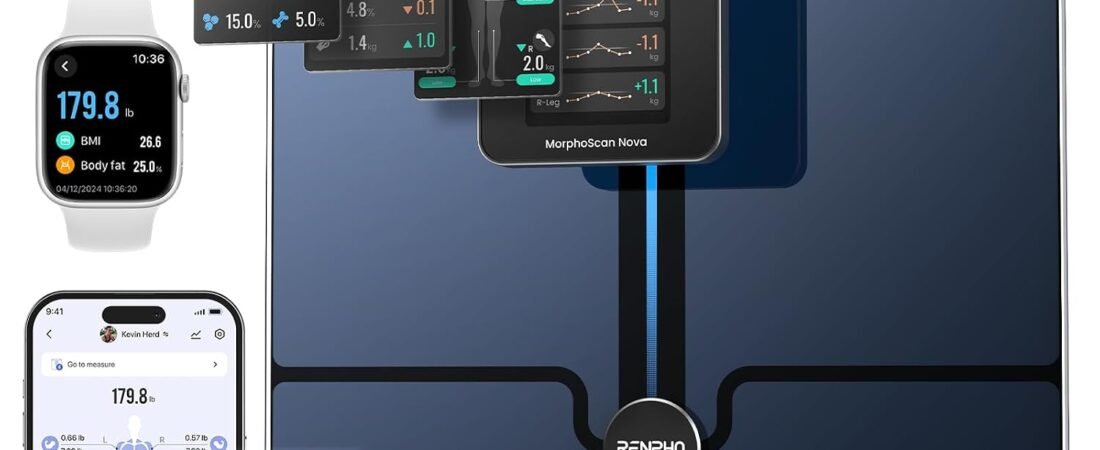
The RENPHO Smart Scale for Body Weight with TFT Handle Display is designed around this connected approach. Instead of relying only on a conventional platform display, the scale includes a handle-mounted TFT display and is designed to provide information about body weight and other measurements associated with body composition. Its rechargeable design also removes the need for regularly replacing disposable batteries.
Smart scales can be useful for people who want to observe changes over time, but the numbers they provide should be interpreted appropriately. Measurements such as body-fat percentage, muscle mass, water percentage, and similar metrics are estimates rather than direct clinical measurements. They can be affected by hydration, food intake, exercise, time of day, and other conditions.
That makes consistency particularly important. Using a smart scale under similar conditions can make trends easier to understand than focusing on one isolated reading.
This guide explores the RENPHO smart scale’s main features, how a handle-display scale can fit into a regular tracking routine, how smart scales compare with traditional scales, and what users should consider when interpreting body-composition information.
What Is the RENPHO Smart Scale?
The RENPHO Smart Scale is a connected bathroom scale designed to measure body weight and provide additional body-composition information.
The product combines several elements into one system:
- A weighing platform
- A TFT handle display
- Smart measurement functionality
- Rechargeable power
- Smartphone connectivity
- Multiple body-composition metrics
- A design intended for household health and fitness tracking
The handle display is an important part of the design. Rather than requiring the user to look down at a small display on the floor, the measurement information can be shown on the elevated handle.
This can make the information easier to see while standing on the scale.
The connected functionality is designed to provide more context than weight alone. Depending on the available features and configured user profile, smart scales can track multiple measurements and help users observe changes over time.
However, the scale should be understood primarily as a consumer wellness and tracking device. Its body-composition estimates should not be treated as medical diagnoses.
Key Features of the RENPHO Smart Scale
1. TFT Handle Display
The handle-mounted TFT display is one of the most noticeable differences between this scale and conventional bathroom scales.
A TFT display can present information in a more detailed and visually organized format than a basic numerical display.
Because the display is positioned on the handle, users do not necessarily need to bend down or look toward the floor to read the measurement.
This design can be particularly convenient for people who want to see several measurements while standing naturally on the platform.
The elevated display can also make it easier to distinguish different readings when multiple metrics are presented.
2. Body Weight Measurement
The primary function remains body-weight measurement.
A smart scale can provide a digital reading that can be recorded manually or integrated into a connected tracking system.
Weight can naturally fluctuate from day to day. Changes in hydration, meals, sodium intake, exercise, clothing, and the timing of measurement can all influence the number displayed.
For that reason, a single measurement is rarely as informative as a longer-term pattern.
Users interested in monitoring changes may find it more useful to weigh themselves under consistent conditions and examine the trend over several weeks.
3. Body Composition Measurements
The product is designed to provide more than body weight.
Smart body-composition scales commonly use bioelectrical impedance analysis, or BIA, to estimate measurements such as body-fat percentage and other composition-related values.
BIA works by passing a very small electrical current through the body and measuring impedance. The device then uses that information alongside factors such as weight and user profile data to generate estimates.
These calculations are not direct measurements of fat, muscle, or other tissues.
The resulting numbers can therefore change because of hydration and other factors.
For general tracking, consistency in measurement conditions is often more useful than treating every individual reading as an exact representation of body composition.
4. Rechargeable Design
The scale is rechargeable rather than relying entirely on disposable batteries.
This can simplify routine use because users do not have to keep a supply of replacement batteries for normal operation.
A rechargeable device does, however, introduce one additional habit: keeping the scale sufficiently charged.
If the scale is used regularly, users should pay attention to the battery level and recharge it when necessary.
The exact charging process and battery-care recommendations should follow the manufacturer’s instructions.
5. Smartphone Connectivity
Connected smart scales can synchronize measurements with a smartphone application.
This provides an advantage over a basic scale because the user can potentially build a longer-term record instead of manually writing down every measurement.
Depending on the software and available functions, users may be able to view historical data, monitor trends, and organize measurements under individual profiles.
App functionality can change as software is updated, so users should consult the current RENPHO application instructions for supported devices and features.
6. Multi-Metric Tracking
The purpose of a smart body-composition scale is to provide a broader view than body weight alone.
Depending on the model and software configuration, the system can provide various measurements associated with body composition.
These can include metrics related to:
- Body fat
- Muscle
- Body water
- Bone-related estimates
- BMI
- Visceral-fat-related estimates
- Other calculated body-composition indicators
The exact measurements available can depend on the model, application version, user profile, and measurement conditions.
These figures are most appropriately used for observing trends rather than as definitive medical measurements.
How the Smart Scale Works
Understanding the basic measurement process can make smart-scale data easier to interpret.
Step 1: Enter User Information
Smart body-composition systems typically use information such as height, age, and sex to help calculate body-composition estimates.
The application may request additional information depending on its configuration.
Accurate profile information matters because the algorithms use these details when estimating body composition.
Step 2: Step Onto the Platform
The user stands on the scale according to the manufacturer’s instructions.
For reliable measurements, the feet should make appropriate contact with the designated areas of the platform.
The scale then measures body weight and, where applicable, electrical impedance.
Step 3: The Scale Processes the Measurement
The device combines the measured information with the user profile and its calculation algorithms.
This produces the displayed body-composition estimates.
Step 4: Data Can Be Stored or Synchronized
When connected to the appropriate smartphone application, measurements can be stored for later viewing.
This creates an opportunity to examine trends instead of relying on memory.
How It Can Be Used in Everyday Life
Morning Weight Tracking
Some people prefer weighing themselves in the morning.
At that point, measurements can be more consistent because the person has generally not consumed a large meal or significant amount of fluid.
However, the most important factor is not necessarily the exact time of day. Consistency is usually more useful.
If someone always weighs themselves at approximately the same time and under similar conditions, the resulting data may be easier to compare.
Fitness Progress Tracking
A smart scale can be incorporated into a broader fitness routine.
Someone participating in strength training, cardio, recreational sports, or another exercise program may use the scale to observe changes in weight and estimated body composition.
It is important not to use the scale as the only measure of progress.
Other indicators can include:
- Physical performance
- Strength
- Endurance
- Clothing fit
- Training consistency
- Recovery
- General wellbeing
A person’s body can change even when body weight changes very little.
Weight-Management Routines
People who are working toward a personal weight-management goal may use connected scale data to observe longer-term trends.
Daily measurements can fluctuate, so users may find it more useful to look at averages or multi-week patterns rather than reacting to every increase or decrease.
A smart scale can provide data, but it does not determine what a healthy target weight should be for a particular person.
Anyone managing a medical condition or significant change in body weight should consider guidance from a qualified healthcare professional.
Household Tracking
Smart scales can be useful in households where several people want to track their own measurements.
Multiple user profiles can help keep individual records separate when the application supports this functionality.
Users should verify how profile management and automatic user recognition work before relying on the feature.
Getting More Consistent Measurements
The usefulness of a smart scale depends partly on measurement consistency.
Use a Hard, Flat Surface
Bathroom scales generally work best on a hard, level surface.
Soft carpeting can interfere with stable weighing.
A firm floor can help the scale sit evenly and reduce unnecessary measurement variation.
Use Similar Conditions
Try to measure at approximately the same time and under similar circumstances.
For example, someone might choose to weigh themselves in the morning after using the bathroom and before breakfast.
The goal is not to create a medically perfect measurement environment. It is to make repeated measurements more comparable.
Stand Still
Movement can affect measurement stability.
Stand naturally and remain still until the scale completes the measurement process.
Avoid Comparing Random Measurements
A measurement taken immediately after exercise may not be directly comparable with one taken first thing in the morning.
Exercise, sweating, food, and fluid intake can change short-term readings.
Look at Trends
A useful approach is to collect measurements over time.
Instead of asking, “Why did my weight change today?” users can consider, “What has happened over the last few weeks?”
This broader perspective can make smart-scale data more meaningful.
Understanding Body Fat Percentage
Body-fat percentage is one of the most commonly discussed measurements on smart scales.
It represents the estimated proportion of total body weight that consists of body fat.
However, consumer BIA scales do not directly measure body fat.
The result is an estimate generated using electrical impedance and other information.
Factors that may influence the reading include:
- Hydration
- Recent food and drink
- Exercise
- Skin temperature
- Time of day
- Foot contact
- Individual body characteristics
This means that a sudden change in the displayed body-fat percentage does not necessarily mean the body gained or lost a corresponding amount of fat overnight.
For general tracking, looking for gradual patterns under consistent conditions is more useful.
Understanding BMI
BMI, or body mass index, is a calculation based on weight and height.
Smart scales can automatically calculate BMI because the necessary information can be entered into the user profile.
BMI can be useful as a broad population-level screening measure, but it does not directly measure body fat and does not account for every difference in body composition.
For example, people with significant muscle mass can have a higher BMI without having an equivalent level of body fat.
Therefore, BMI should be interpreted as one piece of information rather than a complete assessment of health.
Why Weight Fluctuates
Daily body weight naturally changes.
Several factors can contribute to short-term fluctuations.
Hydration
Drinking more or less fluid can change scale weight temporarily.
Food
Food and beverages add mass to the digestive system until they are processed.
Sodium
Changes in dietary sodium can influence water retention.
Exercise
Exercise can temporarily alter fluid levels, particularly after sweating.
Time of Day
Morning and evening measurements can differ considerably.
Clothing
Clothing adds weight and can introduce additional variation.
Understanding these factors can prevent users from overreacting to normal day-to-day changes.
Who May Find This Smart Scale Useful?
Fitness Enthusiasts
People who already track workouts and other fitness information may appreciate having weight and body-composition estimates in the same general routine.
People Monitoring Long-Term Trends
A connected scale can simplify the process of collecting measurements over weeks and months.
Households
Multiple profiles can make a smart scale useful for shared household tracking when supported by the app.
People Who Prefer Digital Records
Anyone who dislikes manually writing measurements into a notebook may appreciate automatic digital data storage.
Users Interested in More Than Weight
Traditional scales answer one primary question: how much does the person weigh?
A smart scale provides additional estimated metrics, which can give users more information to examine.
Important Things to Consider
1. Body-Composition Numbers Are Estimates
This is perhaps the most important point when using a smart scale.
BIA-based body-composition values should not be interpreted as laboratory-grade measurements.
They can be useful for tracking patterns, but a particular reading should not be treated as an exact measurement of body fat or muscle.
2. Consistency Is More Important Than Perfection
Users sometimes become frustrated when body-composition numbers move unexpectedly.
Instead of trying to eliminate every source of variation, it is more practical to standardize the measurement routine.
For example:
- Similar time
- Similar hydration status
- Similar pre-measurement routine
- Same scale
- Same floor location
- Similar foot placement
This can make changes easier to interpret.
3. Not Every Metric Is Equally Useful
Smart scales can provide many numbers, but more data does not automatically mean better information.
For many users, body weight and long-term trends may be more useful than attempting to interpret every available metric.
The most useful measurements are usually those that support a clear personal goal.
4. App Compatibility Matters
Smart functionality depends on the associated application and smartphone.
Before setting up the scale, check the manufacturer’s current compatibility information for your phone and operating system.
App features can also change over time.
5. Rechargeable Battery Requires Planning
A rechargeable scale is convenient, but it still needs to be charged.
If the battery is depleted, smart functions may not be available until the scale is recharged.
For households using the scale frequently, checking the battery level periodically can help avoid interruptions.
6. Floor Surface Matters
The scale should be positioned on a stable, hard, level surface.
Moving it between different locations can introduce differences in measurement conditions.
For consistent tracking, keeping it in one suitable location is generally preferable.
7. Follow Special Safety Guidance
People with certain implanted or electronic medical devices should consult their healthcare provider and the device manufacturer before using a BIA body-composition scale.
The electrical measurement method used by these scales may not be appropriate for everyone.
Pregnant users should also follow the manufacturer’s guidance and consult an appropriate healthcare professional regarding whether body-composition measurement is suitable.
The scale should not be used as a substitute for professional medical assessment.
Smart Scale vs. Traditional Digital Scale
A traditional digital scale focuses primarily on body weight.
A smart scale expands that concept through connected software and additional estimates.
| Feature | Traditional Digital Scale | Smart Body-Composition Scale |
|---|---|---|
| Weight measurement | Yes | Yes |
| Digital display | Yes | Yes |
| Body-composition estimates | Usually no | Yes |
| Smartphone connectivity | Usually no | Yes |
| Historical tracking | Usually manual | App-based |
| Rechargeable design | Varies | Available on this model |
| Setup | Simple | Requires additional configuration |
| Data interpretation | Relatively simple | Requires more context |
Someone who only wants a quick weight measurement may not need connected features.
Someone who wants to monitor multiple measurements over time may find a smart scale more suitable.
Smart Scale vs. Fitness Wearables
Fitness watches and activity trackers can collect information such as movement, heart rate, workouts, and other activity-related metrics.
A smart scale focuses more specifically on body weight and composition.
These technologies can therefore complement each other.
For example, someone could use a fitness wearable to monitor activity and use a smart scale to track weight and estimated body-composition trends.
Neither device should be considered a complete health assessment.
Creating a Simple Tracking Routine
A complicated tracking system is not always necessary.
A straightforward routine might involve weighing yourself on selected days each week and recording the results automatically through the app.
For example, a user might:
- Choose a consistent time.
- Keep the scale in one location.
- Step on under similar conditions.
- Allow the measurement to complete.
- Review the longer-term trend periodically.
- Avoid reacting to isolated daily changes.
This approach can turn a smart scale from a source of random numbers into a more useful long-term tracking tool.
Cleaning and Maintenance
A bathroom scale is exposed to dust, moisture, and frequent foot contact.
Basic maintenance can help keep the platform in good condition.
Wipe the surface according to the manufacturer’s cleaning instructions.
Avoid excessive water exposure, particularly around electronic components.
Do not immerse the scale in water.
If the scale is moved, place it back on a stable, level surface before taking another measurement.
The charging port and other electronic components should also be kept clean and dry.
Frequently Asked Questions
What is a smart scale?
A smart scale is a digital weighing device that can connect to a smartphone or application and may provide additional measurements beyond body weight.
What makes the RENPHO scale different from a standard bathroom scale?
This model combines body-weight measurement with a TFT handle display, smart connectivity, body-composition functionality, and rechargeable power.
What is the purpose of the TFT handle display?
The elevated display allows measurement information to be presented on the handle rather than only on the floor-level platform, making it easier to view while standing.
Does the scale measure body fat directly?
No. Body-fat information from consumer BIA scales is generally an estimate generated from electrical impedance and other user information.
Why can body-fat readings change from one day to another?
Hydration, exercise, food and fluid intake, time of day, and other factors can influence BIA measurements.
Should I focus on one day’s reading?
Generally, long-term trends are more informative than isolated measurements. Daily fluctuations are normal.
Does the scale need a smartphone?
The scale can perform its primary weighing function independently, but smart features and historical tracking may depend on the associated smartphone application and compatible device.
Is the scale rechargeable?
Yes. The product is designed with rechargeable power rather than relying solely on disposable batteries.
Can multiple people use the scale?
Smart scales can support multiple users when the associated application provides multiple profiles. Users should verify the current app functionality and setup instructions.
Can I use the scale on carpet?
For consistent measurements, a hard, flat, level surface is generally preferable. Carpet can make a bathroom scale less stable and may affect readings.
Is BMI the same as body fat percentage?
No. BMI is calculated from weight and height, while body-fat percentage estimates the proportion of body weight consisting of fat. They measure different things.
Can muscle gain cause body weight to increase?
Yes. Muscle has mass, so changes in body composition can occur even when body weight remains stable or increases.
Can the scale replace a doctor or healthcare professional?
No. A smart scale is a consumer tracking device and should not be used to diagnose medical conditions or replace professional health assessment.
Is BIA suitable for everyone?
Not necessarily. People with implanted or electronic medical devices should consult a healthcare professional and review the manufacturer’s guidance before using BIA-based measurements. Pregnant users should also follow appropriate professional guidance.
How often should I use a smart scale?
There is no universal requirement. Some people prefer daily measurements, while others use a scale several times per week or less frequently. Consistency is generally more important than a particular schedule.
Why does my weight seem higher at night?
Weight can naturally be higher later in the day because of food, beverages, hydration, and other temporary factors. Comparing morning measurements with morning measurements is generally more consistent than comparing random times.
Can I use this scale for fitness progress?
It can be used as one source of tracking information. Weight and body-composition trends can complement other indicators such as exercise performance, strength, endurance, and clothing fit.
Conclusion
The RENPHO Smart Scale with TFT Handle Display brings several modern features to a familiar household device. Instead of providing only a basic weight reading, it combines digital weighing, body-composition estimates, smartphone connectivity, a handle-mounted TFT display, and rechargeable power.
The handle display can make measurements easier to see while standing, while the connected functionality can help users build a longer-term record of their measurements. For people interested in fitness, weight-management routines, or simply keeping a digital record of changes over time, these features can provide additional information beyond a conventional scale.
At the same time, smart-scale data needs to be interpreted carefully. Body-fat percentage, muscle-related values, water percentage, and similar metrics are estimates influenced by factors such as hydration, exercise, food intake, and measurement conditions. They are most useful when viewed as trends rather than exact readings.
A consistent routine can make the information more meaningful. Using the scale on a stable surface, measuring under similar conditions, keeping the device charged, and reviewing longer-term patterns can all contribute to a more useful tracking experience.
The most appropriate way to think about a connected body-composition scale is as a personal tracking tool rather than a medical assessment device. It can help organize information and highlight changes over time, but it does not replace professional evaluation when health concerns arise.
For users who want a modern scale that combines weight tracking with connected features, an elevated TFT display, and rechargeable operation, the RENPHO Smart Scale offers a practical format to consider.